
EROS DEFINED
Eros has been defined in many ways by many traditions and thinkers over the centuries. In the modern world, it is largely associated with hedonistic sexuality and eroticism which, for me, strips it of its complexity and sanctity. It is true that sexual energy is an expression of Eros, however, the Western understanding of sexual energy renders it superficial and distorted. Western mainstream culture is, by in large, unconscious of its deep-seated programming in the arena of the body and sexuality.
At its core, Eros is an energy that nurtures self-actualization. It is the energy underlying the process that entices the content of the unconscious mind to rise into consciousness.
To understand Eros, we must first understand that all forms of desire from the basic desire to eat food to the ultimate desire to attain enlightenment, have an important commonality: we want it. This should enable us to recognize that both the mundane and the extraordinary exist on the same spectrum and have the same undercurrent that drives us onward—that compels us to go on living. Within each desire is an instinct to be fully in the human body and experience its miracles: sensation, connection, aliveness, emotion, desire, and a curiosity to find out more—to learn, to discover, to transform, to question . Without this instinct and curiosity human life would be redundant. We would be living in a world devoid of the impulse to experience life. That is to say, Eros (desire) is comprised of two elements: instinct and curiosity.
In this sense, life, from the most mundane to the extraordinary, becomes erotic. Instinct and curiosity make it so. This is because we do not want to do something unless it evokes appeal on some at the most basic survival level to the grand inspiration of the mind. You do not want to eat unless a part of your body demands it, and you do not chase a dream that bores you. Eros encompasses the instinct of the body to survive, the creative nature of our imagination and the reality of evolving consciousness.
On evolving consciousness: En route to the embodiment of one’s true purpose, Eros takes on an alchemical journey of illuminating parts of self that have been fragmented over time. This fragmentation occurred via our societal programming, conditioning and our epigenetic inheritance whereby we, without awareness, became someone we are not, unconsciously sacrificing truth. The pursuit of embodied truth is the only objective of Eros—to help you discover who you are beyond internalized conditions and to come into mind-body-soul coherence. To expand into your latent potential. Eros enables this healing and expansion by leading you into situations where you may learn who you are. For example, if you unconsciously carry a belief that you are not loveable, you will experience situations that reinforce that belief. These situations will repeat until you recognise the pattern and begin to inquire as to why thing are this way. Drawing on the hermetic principle of correspondence ‘as within, so without’, reality emerges from us—our experience of life is a direct reflection of our internal world. Once we understand this, victimhood can drop and empowerment takes it place. You become the orchestrator of your reality rather than consequence of it.
Experiencing the depth of false beliefs opens us up to gaining insight. We meet our freedom to navigate life from an embodied, informed and inspired place.
Eros is the force that takes us on this karmic journey to shed the shackles of oppressive beliefs and low energetic frequencies. It is the grand orchestrator of transmutation, demanding that we meet our shadow (unconscious components of our psyche) in order that we become more self-aware, more sovereign and more creative.
Eros is the dynamic force of growth and movement that encourages us to observe our reality with neutrality. It insists that we meet the duality of life with wonder and awe as both bliss and pain, desire and aversion, pleasant and unpleasant are likewise divine. We can meet everyone and everything with the embodied knowing that all experience is both an invitation to expand into our magnificent potential and simply the impersonal current of consciousness expressing itself through us.
Eros illuminates, purifies and consolidates truth. It enables inner unification with the indwelling spark of God. The final goal of Eros is to unite us with our true self—the fully individuated, actualized person. It drives us toward theosis whereby one rediscovers one’s unceasing connection to the Divine or God. This is the potential that resides in every single being.
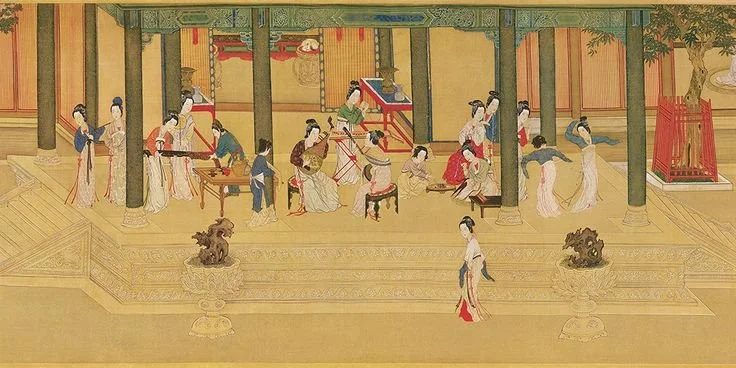
Scene from “Spring morning in the han palace” by Qiu Ying, 1552.